
Andrés Valderrama and Ask Greve Jørgensen
14 February 2019
The objective of this blogpost is to present the differences between these two approaches and tools, because many students of Sustainable Design Engineering and Sustainable Cities Engineering at Aalborg University often set out to do an ANT mapping and end up doing a SHA. So as educators we find ourselves motivated to clarify the difference.
In a nutshell, SHA is a static analytical tool to identify humans in relation to a project, their relative power in the context of a given project and how to treat them. In contrast, ANT is a theory that aims at accounting for how humans and non-humans constitute things (objects, designs, systems, urban areas, urban systems); how these humans and non-humans relate to each other, which controversies they exhibit and how designers and planners can intervene in these dynamics to produce change.
Before we go further, it is important to note a few things. We both find ANT better suited to the kind of work we want to do. Consequently, we use the space here for outlining what ANT offers that SHA does not, rather than giving the analytical approaches equal treatment. Furthermore, we want to note that this particular account of SHA and ANT is a work in progress. We try to outline a few points that we find are important here, but this is not to be taken as a comprehensive account of either SHA or ANT.
Stakeholder Analysis SHA
In stakeholder analysis, stakeholders are human actors. They can either be human organizations, for example departments, groups inside an organisation, whole organisations, or individuals. What makes them stakeholders is that they have or may have a stake in a project. As a management tool, stakeholder analysis is conceived as a way for the project managers to identify and manage appropriately the relations to stakeholders to make a given project have the best impacts and the least problems.
According to https://project-management.com/what-is-stakeholder-analysis/
”Stakeholder Management processes for a project involves (but not limited to)
- Identifying all stakeholders
- Documenting stakeholders needs
- Assessing & analyzing stakeholders interest/influence
- Managing stakeholders expectations
- Taking actions
- Reviewing status & repeat”
SHA is often reduced to the following visualization where the project manager maps the different stakeholders in order to know how to communicate with them:

So those stakeholders placed in the upper right quadrant (1) have a high potential of supporting the project but have low potential of influence. Therefore project managers should involve these actors to increase support. In the lower right quadrant (2) are those who have low potential of support and low influence. They are marginal to the project, but should be monitored and informed to keep them up to date. In the lower left quadrant (3) there are those with low supportive capacity, but potentially high influence in the project. Managers should be careful of these actors and defend the project from them, as they might become a major threat to the project if ignored. Finally in the upper left quadrant (4) are those who are highly supportive and have high influence. They are active collaborators and should be treated as such.
As you can see, SHA is a mapping tool that helps project managers to relate to other stakeholders by offering predefined categories of actor types and prescriptions for their proper management.
Actor-Network Theory
One of ANT’s main characteristics is that it starts by asking not only who is involved, but also what is involved. A distinguishing attribute of ANT is that everything, including designs, cities, atoms, planets, consciousness, citizenship, is constituted by networks of actors which are both human and non-human. For example, citizenship can be said to be the effect of network made up of a person, a living human body, a personal number in an official database in a country, an identifying document such as a passport or a social security card, just to name a few. For ANT, the relation between all these actors (the person, the body, the number in the database, and the physical passport…) constitute the citizen.
Another important feature of ANT is that it has a dynamic notion of social order. The order (for this purpose, around a project) is considered as never completely settled and therefore always open for renegotiation. Bruno Latour writes that,
“instead of […] imposing some order beforehand, ANT claims to be able to find order much better after having let the actors deploy the full range of controversies in which they are immersed” (Latour 2005, p. 23)
Therefore, when you claim to map an actor-network, you look at a setting, explore the different positions taken up in that setting, and the controversies present, to determine an order. The order here means who and what gets to act on behalf of others, human as well as non-human actors. As such, it is a matter to be investigated, whether any element present has the ability to act. Furthermore, the relative power of one discovered actor over another is just as much a matter to be explored. It should never be considered a given and specially not a theoretical given.
While doing this, keep in mind that ANT is relational theory. In the example above, a citizen is only a citizen through the relations between a person, a database entry, and an issued ID (of course, this list could be expanded quite a bit more). This is also the case for power, being not a thing or quality that an actor possesses, but rather a set of relations that would enable one actor to act through or on behalf of other actors.
Summing up, this means that there are several things that can only be determined after the analysis is carried out:
- Who the actors in a situation are
- What the actors are up to
- How powerful the actors are
- How you (as a sustainable engineer) should engage with actors in a situation
- Whether or how actors are or can be interested in your actions
Here, an ANT mapping is significantly different from a stakeholder analysis, where you are in a defined role as a project manager, with a defined agenda. Therefore, SHA is a structured tool, that results in a snapshot of the power configuration around a project. It tends to put the role of the project manager (you) at the top of the social order. Other stakeholders should be managed for your project to succeed. An ANT mapping, in contrast, is more open, in that it allows for actors to reveal (through your analysis) how powerful they are, or can be, and what they are up to.
An open or a structured approach
So far, we have made the argument that an ANT mapping is a way of knowing less beforehand about the actors related to a project. How could this be a good thing, you might ask. Our argument here is that
- The ANT approach enables you as researchers/engineers to listen and observe more carefully to (human and non-human) actors.
- The kind of thinking that SHA enables you to do, is less well suited for creating sustainable transitions.
We believe that ANT is an approach that enables you to take more things into account, and that puts you in a dynamic relation to the problem or project examined. By not knowing which actors are powerful beforehand, and by putting yourself in a position where other actors should be convinced rather than managed, you are more likely to make projects that foster lasting change.
SHA is in a sense a snapshot, that settles who the stakeholders are and thus how you should deal with them. But when we look at what you do with it, we see a linear thinking approach to project management: 1) You identify stakeholders. 2) You manage them. 3) Success! (with whatever you wanted to do). We are, of course, making a bit of a caricature of SHA at this point. In this sense, we may point to our caricature of stakeholder analysis (identify, manage, success!) as a modern tool for project management, carrying in it a modern perception of time. Following Bruno Latour in We have never been modern(1993), the modern perception of time is as an irreversible arrow, ever going forward, progressing, and in doing so destroying its past (Latour 1993, pp. 67). Conversely, ANT as a non-modern or never-modern theory insists that time was always many things at once, and that we should act accordingly to confront the predicaments that the modern times have carried with them.
This could get hairy, but we will stick to the point: we consider that a competent sustainability engineer should be aware of working along irreversible time-arrows, and always be willing to turn, return, or work backwards. One of the ways you can do this, is to acknowledge that there is always something already going on when you arrive. To be specific, people are already engaged in building worlds and negotiating social order when you enter with your project.
A non-linear way of mapping actors might look something like this where all these processes happen concurrently:
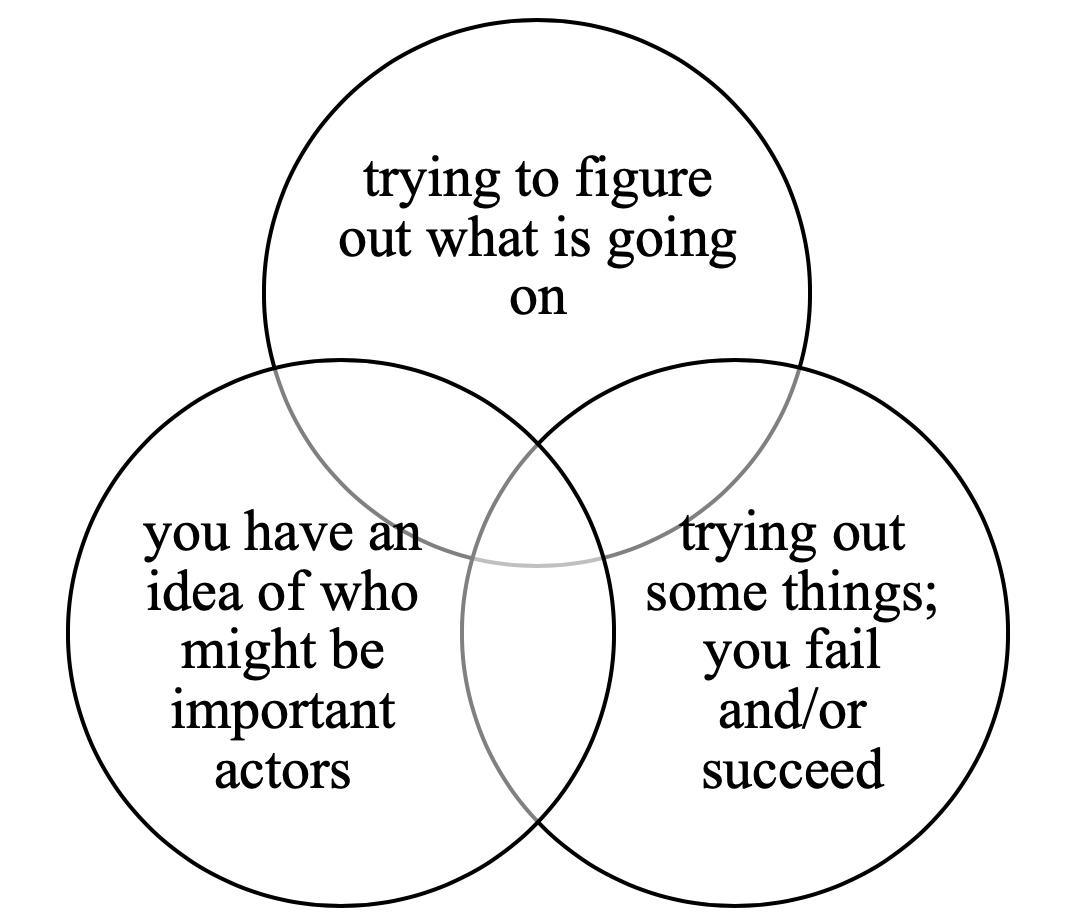
Your project usually ends when it is time to hand in the written report. By then, you probably have a better idea of who might be important actors and why. Doing ANT mapping is a sense making process for you to be able to account of what and who might be able to become what in your project. Or in other words, what kind of actor orderings are required to produce sustainability and how to achieve them.
A few guidelines
What do you do along the way, if you only know how things look like at the end? We would suggest that you work with mapping actors continuously, but always treat your maps as preliminary. Keep in mind, as we noted above, that actors are always human and non-human, and that their capacity to act should be understood as an effect of their relations to other actors. Again, the relative power of actors is an effect of their relations in their specific situation. A passport might be a powerful actor in constituting citizenship at a border control, but less so at a voting ballot, for instance.
Pay more attention and draw the relationships. The typical mistake that makes an ANT into a STA is when you focus only on plotting the actors, naming them, differentiating them. Then you typically end with actually what is less than a SHA, because you only have a bunch of actors connected with the same type of line. A good ANT presents actors and relationships in as much detail as possible. And good ANT mappings are never static, they always present contrasts between current situations and desired situations, or past situations and current situations. So a good ANT has at least two visualisations to illustrate the analysis, but ideally it has several to show contrast between different mappings of current situations and different mappings of possible situations.
Examples
The following figure is part of an intended Actor-Network Analysis which is available at http://jeniferbuckley.com/food-agriculture/research/ant/
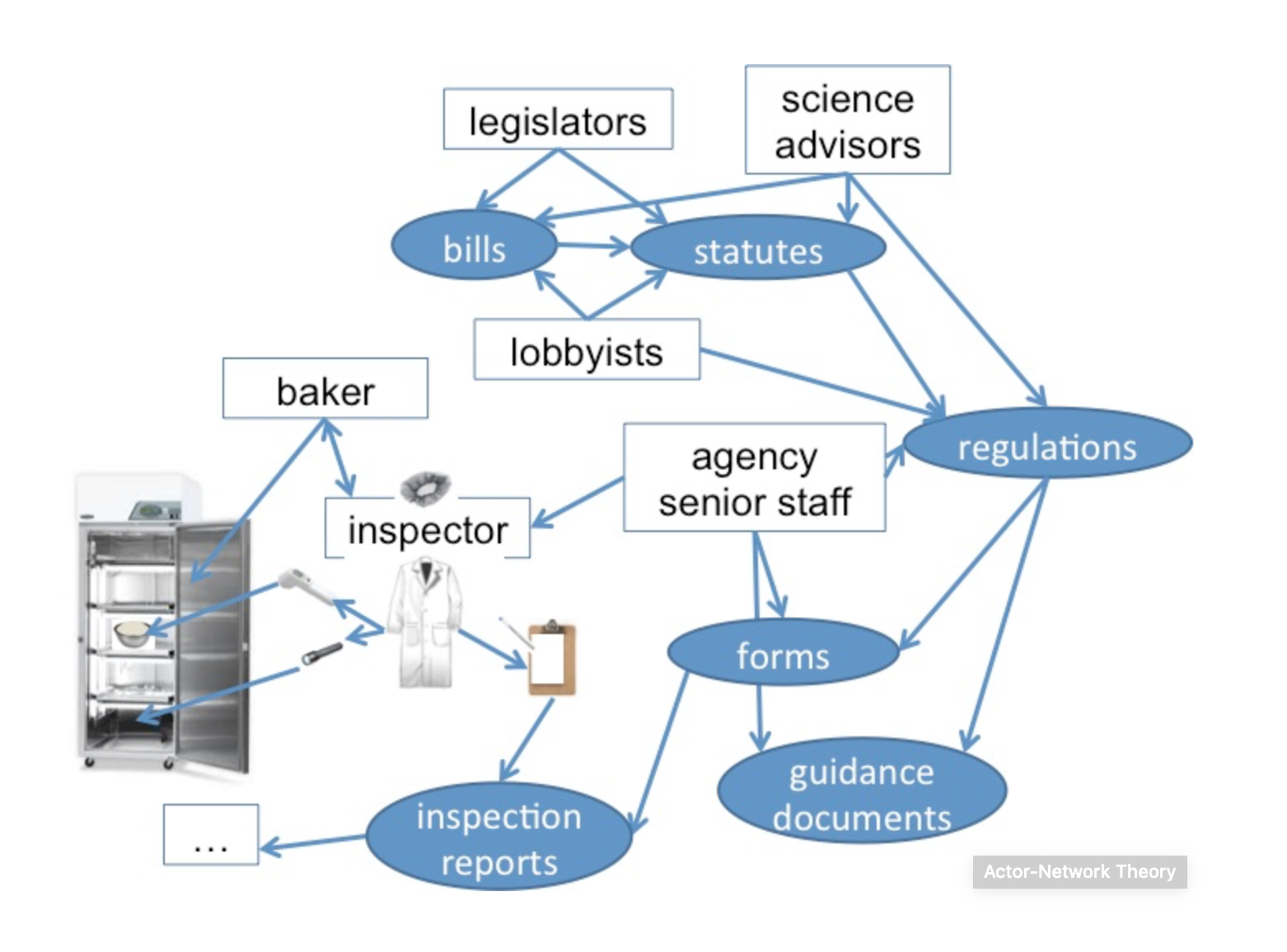
As you can see the figure presents detail about the actors, both human and non-human. However there is very little information about the relationships between them. Additionally the figure does not have a clear visual structure. Therefore we consider that these kind of visual mappings are very poor ANT, and they don’t even become a good Stakeholder Analysis.
The following Actor-Network figure is part of a design project where the authors propose a new re-use dish system for Torvehallerne in Copenhagen.
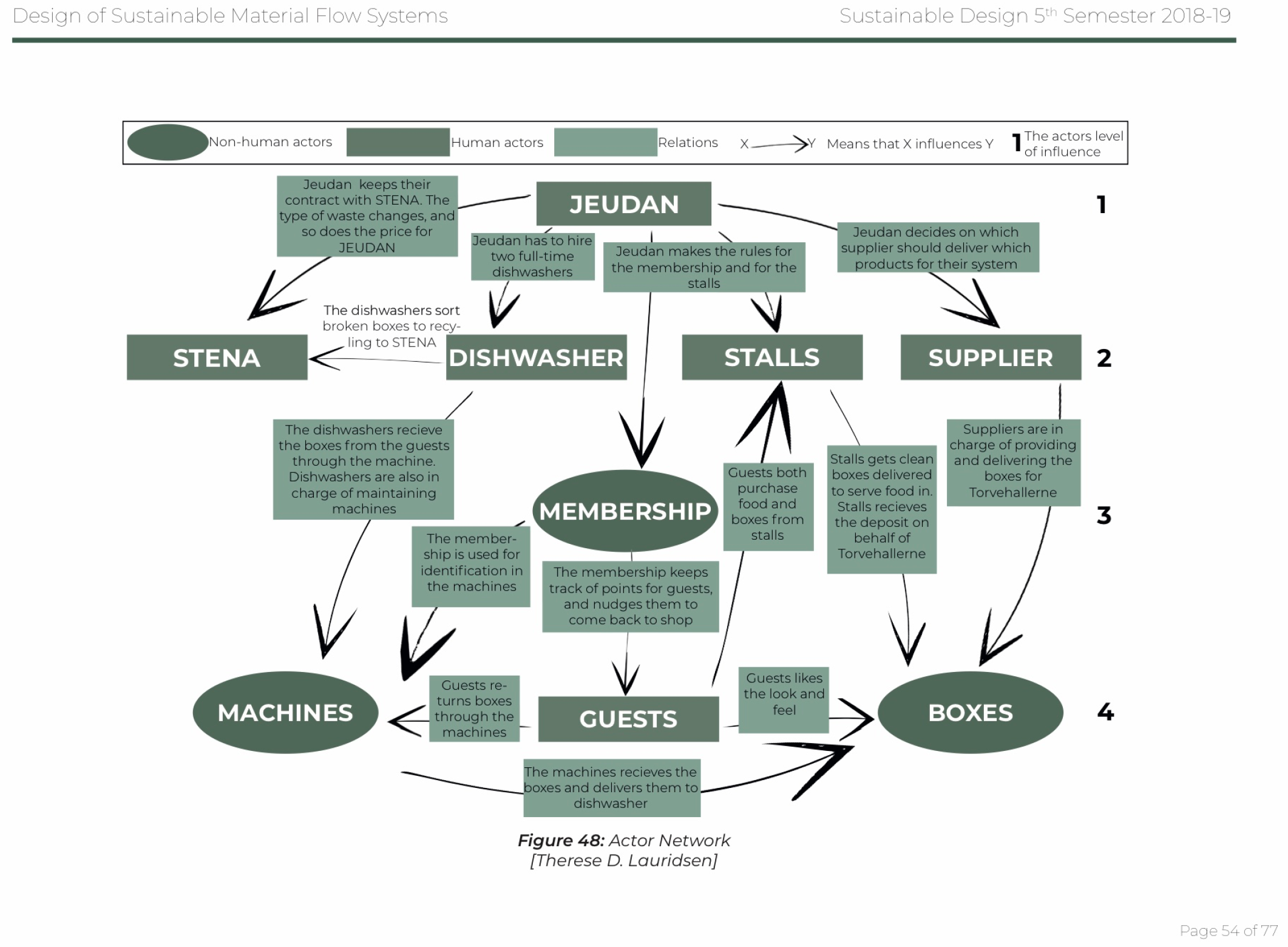
This is a very good figure to complement a narrative presentation of the solution, because ANT mappings are always a combination of visualizations and narratives. Note that there is very good detail about the relationships between the actors, which are both human and non-human. Additionally, the figure presents different levels of influence according to the relative vertical positioning and indicated by numbers 1 to 4, where 1 is more level of influence and 4 is less level of influence. Moreover, in this design project the authors made an ANT analysis of the current situation, and of the different concepts considered, and of the solution. By creating these mappings that contrast current situations, with possible situations, they take advantage of the dynamic character of ANT.
Conclusion
Sustainable Design Engineers and Sustainable Cities Engineers should learn when and how to use Actor-Network Theory ANT or Stakeholder Analysis SHA. If they choose to do and ANT analysis, they should at least draw and describe actor-network mappings that contrast the existing situation with a desired one. Best if they can make several mappings that show the contrast between the existing, the possible (alternatives) and the final solution selected by the project group. Bear in mind that all these mappings are provisional and not the definite truth as modernity would have it.
If, on the other hand, the idea is to map the human actors present in a situation and figure out how to communicate with them, then it is best to use a Stakeholder Analysis according to the established literature on the field. This can also be useful. What is not acceptable is to claim doing an ANT and then doing a SHA or something that does not amount to either.
References and further reading
Latour, Bruno (1993). We have never been modern. Harvard University Press.
Latour, Bruno (2005). Reassembling the social.Oxford University Press.
Mitchell, R., Agle, B., & Wood, D. (1997). Toward a Theory of Stakeholder Identification and Salience: Defining the Principle of Who and What Really Counts. The Academy of Management Review, 22(4), 853-886. Retrieved from http://www.jstor.org/stable/259247
Pouloudi, A., Gandecha, R., Atkinson, C., & Papazafeiropoulou, A. (2004). How stakeholder analysis can be mobilized with actor-network theory to identify actors. In Information Systems Research (pp. 705-711). Springer, Boston, MA.
 sustainabletransitions